
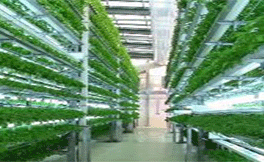
Several fertilizer trading firms, each with over one decade of experience, have been merged to form IPCC INDIA Group. This merger brings together much experience of working with main producers of the products worldwide. We supply wide range of chemicals, including but not limited to the fertilizers products and their derivatives.
Fertilizers are substances that supply plant nutrients or amend soil fertility. They are the most effective [quantify] means of increasing crop production and of improving the quality of food and fodder. Fertilizers are used in order to supplement nutrient supply in the soil, especially to correct yield-limiting factors.
- Liquid DAP
Liquid Fertiliser
ORGANIC + DAP
18:46:00
S⁴ Technology®
Ea² Technology®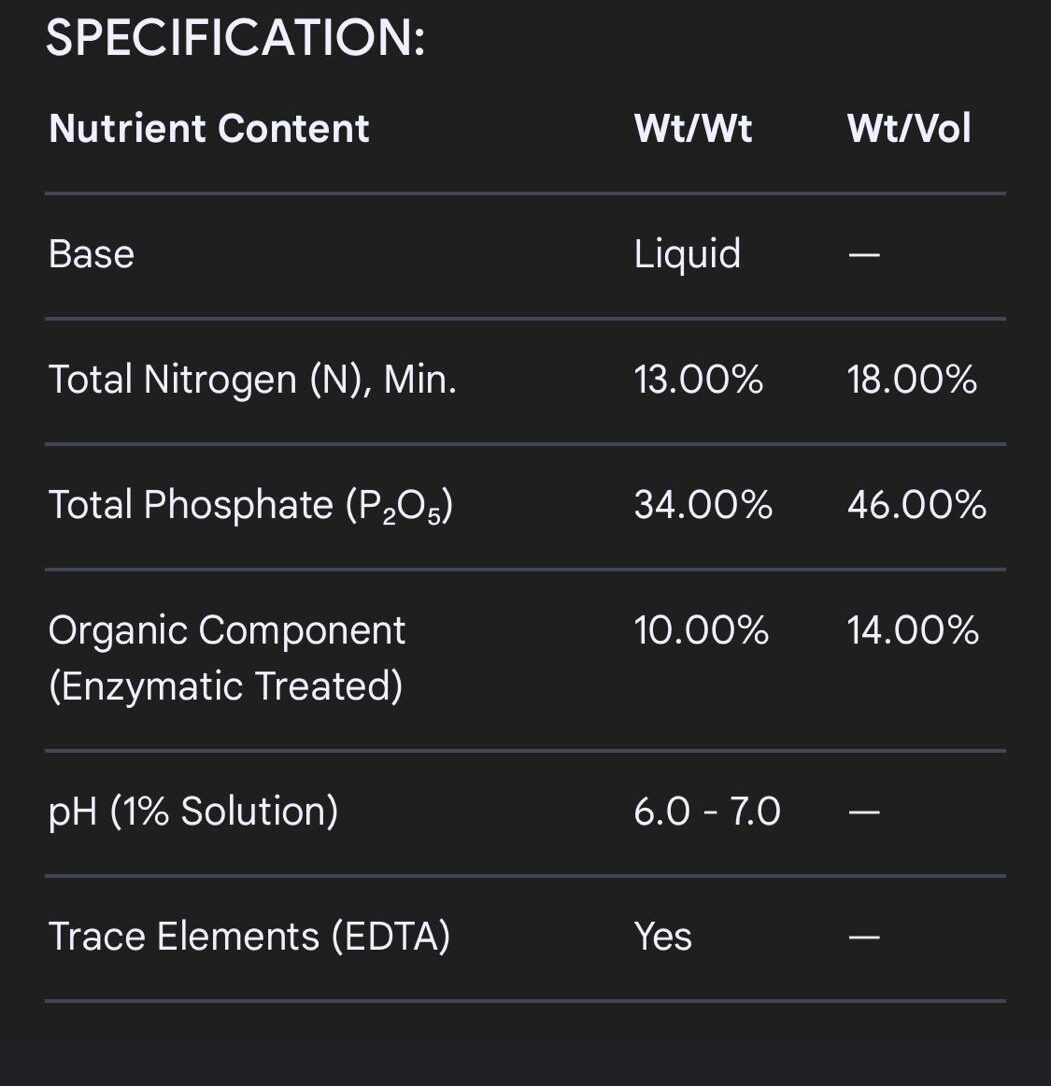
PACKING : 200 ltr HDPE Barrel
RECOMMENDED CROPS:
For Fertigation:
Fruiting crops such as tomatoes, peppers, cucumbers, eggplants, strawberries, and melons. Root vegetables like carrots, beets, radishes, and potatoes. Leafy green vegetables, including lettuce, spinach, kale, cabbage, ornamental plants, and leguminous crops.
For Foliar application:
All crops.
OUR SPECIAL DIVISION WITH EXPERTISE IN
- NANO TECHNOLOGY
- ORGANIC CROP PROTECTION
- SPECIALITY IN BIO STIMULANTS
- SPECIALITY IN CROP NUTRITION
- BIO AGRO CHEMICALS & PESTICIDES
- MICROBIAL EXTRACTION TECHNOLOGY
- BOTANICAL EXTRACTION TECHNOLOGY
- OUR VISION
Our vision is to help create a sustainable agriculture system that meets the needs of present and future generations without degrading human health and the environment. - OUR MISSION
We believe in offering our customers efficient solutions for their unique requirements and consistently strive to provide customized, innovative, and quality products like Bio Pesticides, Micro Nutrient, Liquid Fertilizers, Flowering Growth Stimulants, NPK Fertilizers etc., to our worldwide clients.
Talking about fertilizers, many people seem to prefer the organic kind as opposed to the chemical-laden artificial ones that can be quite harmful to the environment. Organic fertilizers have two types. One is the synthetic kind, which means that it is organic compound artificially produced. The perfect example for this is Urea, a common organic fertilizer used by most to promote blooming.The other type is known as natural organic fertilizers for obvious reasons. A hundred percent of the ingredients used to create a typical natural organic fertilizer come from nature, like fish extract, seaweed, and manure, guano, and compost materials.
Natural organic fertilizers are traditionally applied like tea to the soil. But with new developments in how natural organic fertilizers are made, they can now also be applied through different means. Natural organic fertilizers can be applied through spray canisters or by pouring (for liquid natural organic fertilizers)
| Urea |
|---|
| This type of fertilizer is usually available to the public in a white, crystalline, organic form. It is a highly concentrated nitrogenous fertilizer and fairly hygroscopic. This also means that this fertilizer can be quite difficult to apply. Urea is also produced in granular or pellet forms and is coated with a non-hygroscopic inert material. It is highly soluble in water and therefore, subject to rapid leaching. It is, however, quick-acting and produces quick results. When applied to the soil, its nitrogen is rapidly changed into ammonia. Similar to ammonium nitrate, urea supplies nothing but nitrogen, and the application of Urea as fertilizer can be done at sowing time or as a top-dressing, but should not be allowed to come into contact with the seed. 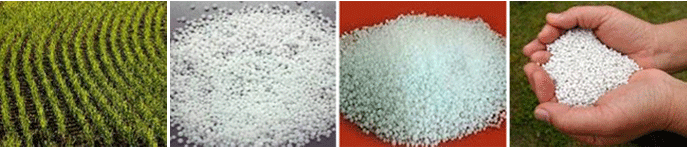 Urea is non-flammable in case of fire, may be sprayed with water without developing chemical water will damage the product. |
| Specifications |
| COMMERCIAL NAME | UREA |
|---|---|
| CHEMICAL FORMULA | CO(NH2)2 |
| Total nitrogen | 46.0%wt |
| Moisture | 0.3%wt |
| Biuret | 1.0%wt |
| Ammonia | 150 ppm |
| Iron | 5.0 ppm |
| Formaldehyde | 0.35% wt |
| Density | 0.750 – 0.03 kg/dm3 |
| Ph (150c) (solution 10%) | 7.5 – 8.5 |
| Granular size | (2-4.5 mm)=90.0% > 1.0mm = > 1.0% |
| ORIGIN | EGYPT |
Ammonium Nitrate
This fertilizer type also comes in white crystalline salts. Ammonium Nitrate salts contain 33 to 35% nitrogen, of which half is nitrate nitrogen and the other half is in the ammonium form. As part of the ammonium form, this type of fertilizer cannot be easily leached from the soil. This fertilizer is quick-acting, but highly hygroscopic, thus making it unfit for storage.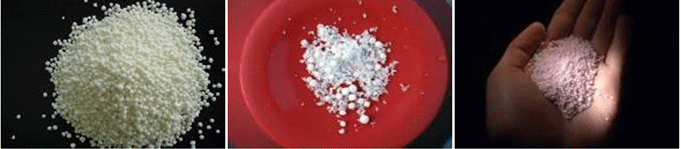
| COMMERCIAL NAME | UREA |
|---|---|
| Ammonium Nitrate Content (dry base) | 99.57 % |
| Water insoluble substances | 0.01% |
| PH value (in 10% AN solution) | 0.3%wt |
| Nitrogen | 34.85% |
| Moisture | 0.3% |
An inorganic fertilizer, also known as a chemical fertilizer or a synthetic fertilizer is artificially made in the labs and contains all the vital nutrients such as nitrogen, phosphors and potassium, which are present in the organic fertilizers. Unlike organic fertilizers, inorganic fertilizers do not have to be broken down before being absorbed by plants as the nutrients present in them are easily absorbed. The main advantage that inorganic fertilizers have over organic fertilizers is that they can be used immediately to rescue dying plants. The main advantage that inorganic fertilizers have over organic fertilizers is that they can be used immediately to rescue dying plants.
This is because the nutrients present in them are easily absorbed by the plants and unlike the nutrients present in organic fertilizers, do not need to be broken into primary nutrients for absorption by plants. Organic fertilizers effects can get delayed and by that time a plant can die completely. Another advantage that inorganic fertilizers have over organic fertilizers is that they are easily available at most gardening stores and hence, are quite convenient to use. On the other hand, making inorganic fertilizers can take a lot of time as well as effort. Decomposition process in making organic fertilizers is time consuming, which delays the making of organic fertilizers.
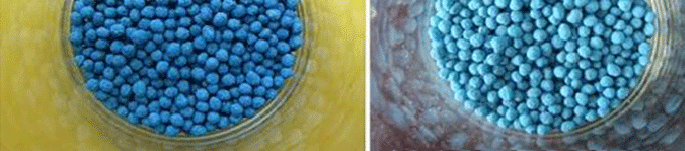
NPK
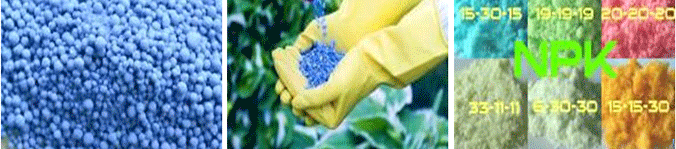 | The product is a kind of granular solid fertilizer consisting of nitrogen (N), phosphate (P2O5), Potassium (K2O). Advantages:  – Fully soluble in water & can be used in all irrigation systems. – With acidic effect, leading to an increase availability of micronutrients and phosphorus. Increases yield and improves the quality of fruits.– Increases the rigidity of potato tubers & increases their ability to storage. – Increases plant tolerance to drought. |
NPK Fertilizer
The product is a kind of granular solid fertilizer consisting of nitrogen (N), phosphate (P2O5), Potassium (K2O) and many medium and trace elements (e.g. iron, magnesium, zinc, boron, manganese, etc). Its processing formula can be designed according to soil conditions of different areas and demands of different plants. We can provide a variety of general-purpose compound (mixed) fertilizers as well as specific fertilizers with high, medium or low concentration for varied demands. Meanwhile, we can organize production and supply according to customers requirements.
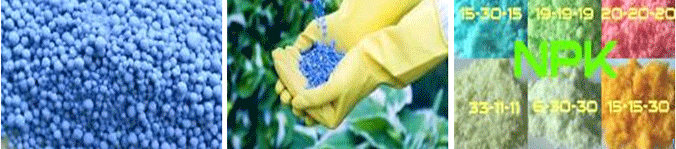
| Potassium sulphate | 0/0/50 |
| Calcium Nitrate | 11/0/0/26 |
| Urea Phosphate | 17/44/0 |
| Mono- Ammonium Phosphate | 12/61/0 |
| Mono- Potassium Phosphate | 0/52/34 |
| NPK(fully soluble powder) | 19/19/19 |
| NPK(fully soluble powder) | 20/20/20 |
| NPK(fully soluble powder) | 12/3/43 |
| NPK(fully soluble powder) | 9/0/46 |
| NPK(fully soluble powder) | 6/6/43 |
Farmers and gardeners apply phosphate-based fertilizer to plants and soil to boost local phosphorus (P) levels. Young plants are especially vulnerable to deficient P levels, but almost every plant needs it to maintain healthy growth. Artificial phosphate fertilizer and manure or compost are used together to revitalize severely depleted soil. Phosphate fertilizers fall into one of four basic categories: rock phosphates, superphosphates, ammonium phosphates or polyphosphates. Each type of fertilizer is composed of different substances and chemical ratios.
- Rock Phosphate
- Single Super Phosphate
- Diamond Phospate
- Tab 4
Rock Phosphate
Deposits of rock phosphate form naturally in geological formations. It is harvested, ground into powder, and added to soil as a source of phosphorus. A Michigan State University bulletin, titled “N-P-K Fertilizers,” reports a steady decline in the availability of rock phosphate on the market. The author cites the material’s high transportation costs and poor water solubility as catalysts for its diminished use in agricultural practices. Rock phosphate still has limited use in domestic cultivation and is refined as an ingredient in other advanced fertilizers.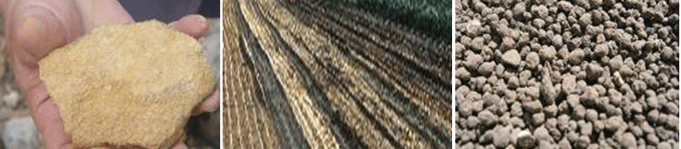
Origin: Egypt
Specifications: Rock Phosphate 30%
| Element | Percentage (%) |
|---|---|
| Phosphorus Pentoxide (P₂O₅) | 30% Min (Dry Basis) |
| Calcium Oxide (CaO) | 48.0 – 49.5% |
| Silicon Dioxide (SiO₂) | 5.00 – 6.50% |
| Carbon Dioxide (CO₂) | 4.50 – 5.20% |
| Fluorine (F) | 3.00 – 4.10% |
| Iron(III) Oxide (Fe₂O₃) | 1.90 – 2.20% |
| Sulfur Trioxide (SO₃) | 1.50 – 2.0% |
| Magnesium Oxide (MgO) | 0.30 – 0.40% |
| Aluminum Oxide (Al₂O₃) | 0.30 – 0.50% |
| Sodium Oxide (Na₂O) | 0.40 – 0.60% |
| Potassium Oxide (K₂O) | 0.04 – 0.06% |
| Chloride (Cl) | 0.05 – 0.09% |
| Loss on Ignition (L.O.I) | 6.50 – 7.50% |
| Calcium Carbonate (CaCO₃) | 10.20 – 11.80% |
| Moisture (H₂O) | 34% Max |
This table details the typical elemental composition of phosphate rock, expressed as a percentage by weight.
Size Analysis
| Free Flowing | Fluidity |
|---|---|
| 3 | +4 mesh (4.75 mm) |
| 68-72 | -4 mesh to + 100 mesh (4.75 mm -0.16 mm) |
| 14-16 | -100 to + 200 mesh (0.16 mm to 0.08 mm) |
| 10-12 | -200 to +270 mesh ( 0.008mm to 0.05 mm) |
| 2-4 | -270 mesh (0.05 mm) |
Rock Phosphate 28%
| Value(%) | Element |
|---|---|
| 28% Min | P2o5 ( Dry basis at 100 / 105 c) |
| 48.0 – 49.5 | Cao |
| 0.30 – 0.40 | Mgo |
| 0.30 – 0.50 | Al2o |
| 31.90 – 2.20 | Fe20 |
| 30.04 – 0.06 | K2O |
| 5.00 – 6.50 | SiO2 |
| 3.00 – 3.10 | F |
| 0.40 – 0.60 | Na |
| 0.05 – 0.09 | CL ( w.s.) |
| 4.50 – 5.20 | Co |
| 26.50 – 7.50 | L.O.I |
| 10.20 – 11.80 | CaCO |
| 31.50 – 2.0 | SO3 |
| 4% | maxH 2O |
Size Analysis
| Free Flowing | Fluidity |
| 3 | +4 mesh (4.75 mm) |
| 68-72-4 mesh to + 100 mesh (4.75 mm -0.16 mm)14-16-100 to + 200 mesh (0.16 mm to 0.08 mm)10-12-200 to +270 mesh ( 0.008mm to 0.05 mm)2-4-270 mesh (0.05 mm) |
Normal super phosphate is a stronger and more soluble compound than rocky phosphate, but it is significantly less potent than concentrated super phosphate or ammonium compounds. The newer concentrated compound contains 46 percent phosphate, while the normal variety has 20 percent. Neither of the two is supplying nitrogen, a desirable nutrient found in other fertilizers.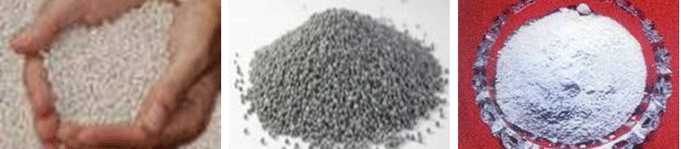
Powder single superphosphate fertilizer (P.S.S.P)
Specifications ItemResultColourGrayMoisture7% max.Free acidity ( as P2O5 )5% max.Total P2O518 +/_0.5 % min. on dry basisWater soluble P2O515+/-0.5% min. on dry basisCitrate soluble P2O516 +/- 0.5% min. on dry basisSulphur ( S )11% min. on dry basisCalcium (Ca)18% min. on dry basis
Granulated single super phosphate fertilizer (G.S.S.P)
SpecificationsItemResultColourGrayMoisture4% max.Free acidity ( as P2O5 )3% max.Total P2O520 % min. on dry basisWater soluble P2O516 % min. on dry basisWater and Citrate soluble P2O518 % min. on dry basisSulphur ( S )11% min. on dry basisCalcium (Ca)18% min. on dry basisGrain sizeOver 5 mm : 3.0% max.
From 1 – 5 mm : 94.0% min.
Under 1 mm : 3.0 % max.
Powder single superphosphate fertilizer ( P.S.S.P )
Diammonium Phosphate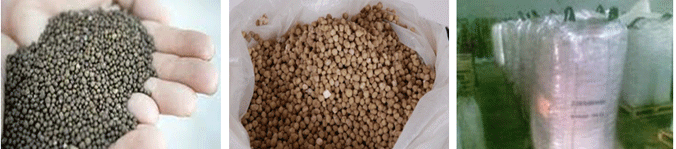
Specification
Origin: Morocco
Test Percent
TOTAL P2O5: 46 PCT MIN47.3 PCT MINP2O5 water soluble: 43 PCT MIN44.5 PCT MINTotal Nitrogen (N): 18 PCT MIN18.2 PCT MINMOISTURE (H2O): 2 PCT MAX0.53 PCT MAXGRANULOMETRY 1-4 MM: 18 PCT MIN940.9 PCT MINAppearanceBrown, free from foreign material, free flowing and treated with anti caking agentsPowder single superphosphate fertilizer ( P.S.S.P )
Granular Triple Super Phosphate
Triple Super Phosphate is made by the action of Phosphoric Acid on raw Rock Phosphate [also called Appatite]. It typically contains 46% Phosphate, soluble in neutral ammonium citrate and water. Of this, typically 90% is soluble in water alone. Because the phosphate on TSP is never completely water-soluble, it cannot be used in the manufacture of clear-liquid fertilisers.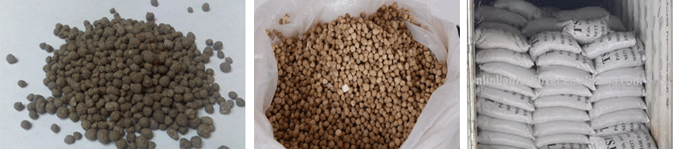
Diammonium Phosphate
Specification
Origin: Morocco
Test Percent
TOTAL P2O5: 46 PCT MIN47.3 PCT MINP2O5 water soluble: 43 PCT MIN44.5 PCT MINTotal Nitrogen (N): 18 PCT MIN18.2 PCT MINMOISTURE (H2O): 2 PCT MAX0.53 PCT MAXGRANULOMETRY 1-4 MM: 18 PCT MIN940.9 PCT MINAppearanceBrown, free from foreign material, free flowing and treated with anti caking agents
Powder single superphosphate fertilizer ( P.S.S.P )
Specification Origin:Egypt ELEMENTS:PERCENT:TOTAL P2O546 PCT MINWATER / CITRATE SOLUBLE P2O544 PCT MINWATER SOLUBLE P2O540 PCT MINFREE ACID AS P2O57.00 PCT MAXMOISTURE4.00 PCT MAXGRANULOMETRY 1-5 MM90 PCT MINSpecification Origin:Egypt ELEMENTS:PERCENT:TOTAL P2O5MIN 47 %WATER / CITRATE SOLUBLE P2O5MIN 46 %WATER SOLUBLE P2O5MIN 43 %FREE ACID AS P2O57.00 PCT MAXMOISTURE4.00 PCT MAXGRANULOMETRY 1-4 MM90 PCT MIN |