
2003 – TO IPCC GROUP – 2023 – Our Journey FOUNDER CEO – Prof. Dr. Anita Singh Matharu
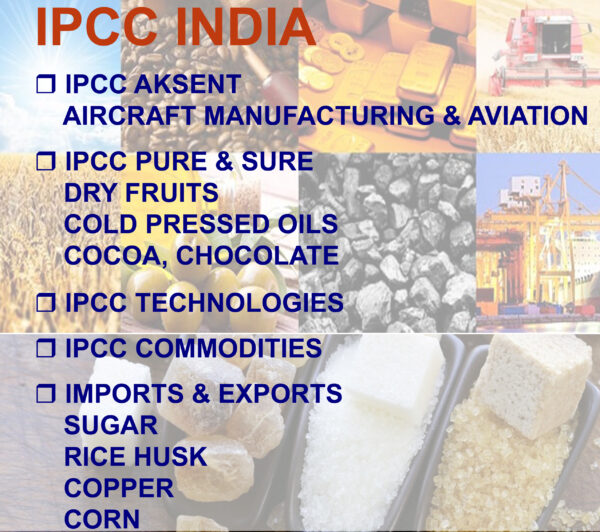
It was first established as an Import & Export Company alongside International Project Consultancy, worked with the Ministry of Chemical & Fertilisers, Government of India, through the Canalising agencies such as Indian Potash Limited, MMTC, STC to procure Chemicals & Fertilisers for the Government of India.
As the years rolled by, we have seen steady growth. We grew from strength to strength as we dabbled in various sectors. We worked with Ministries in India & abroad for Global Tenders, PPP Projects, and Imports Exports. We also worked on EU standards, Accreditation, Affiliations, Cutting Edge Technology, Education / Training and Foreign Investments. As we set forth and travelled to foreign lands, we found the need to form more companies. We did just that, and the IPCC was set up in various countries to form the IPCC GROUP of Companies.
In India, we are registered under MSME Udyam under the License of IPCC INDIA.
- Fertilisers & Chemicals
- Coffee
- Sugar
- Copper
- Wheat
- Cocoa
- Corn
Several fertilizer trading firms, each with over one decade of experience, have been merged to form IPCC INDIA Group. This merger brings together much experience of working with main producers of the products worldwide. We supply wide range of chemicals, including but not limited to the fertilizers products and their derivatives. Fertilizers are substances that supply plant nutrients or amend soil fertility. They are the most effective [quantify] means of increasing crop production and of improving the quality of food and fodder. Fertilizers are used in order to supplement nutrient supply in the soil, especially to correct yield-limiting factors
While coffee production occurs in many countries around the world, Brazil is the major producer followed by Vietnam, Indonesia and Columbia. The biggest consumer of coffee is the U.S. followed by Germany and Italy.
There are two types of coffee beans, Arabica and Robusta. Arabica beans are considered more flavorful and therefore command a premium in the market. Robusta beans tend to be bitter and less palatable but have a 50% higher concentration of caffeine than the Arabica bean. Robusta beans are sold for about 70% of the price of Arabica and are therefore more commonly traded by the big four coffee companies, Kraft, Nestlé, Procter and Gamble and Sara Lee who purchase approximately 50% of all coffee worldwide.
Sugar is derived from two plant sources, sugar cane and sugar beet. Sugar cane is the main source of sugar in tropical climates and sugar beet in temperate and mild climates. The sugar derived from both these sources is 99.8% pure sucrose, a complex sugar composed of glucose and fructose. Today, sugar is produced by over 120 countries around the world for both domestic and international use.
The primary source of sugar is sugar cane which account for 78% of the market. Brazil is the largest producer with over 30 million tonnes per year, followed closely by India with over 27 million tonnes and the EU running third with 17 million tonnes per year. Brazil’s production account for 20% of the world’s total sugar supply.
The sugar industry is unique compared to other commodity markets because as much as 70-80% of the sugar produced in each country is consumed by that country. This has led to a market rife with subsidies and unfair market pricing.
Copper is the oldest known tradeable commodity in the world. As a commodity it has a number of appealing features. It’s price is closely tied to the state of the economy. A recovery in the global economy will indicate an increase in the demand for copper due to the increase in housing construction for which copper is a key component. Copper is used in electrical wiring and plumbing due to its anti-corrosive and conductive properties. It is also used to produce coinage in some countries and its anti-bacterial properties are used to fashion wrist bands and necklaces by individuals practicing alternative medicine.
The United States and Russia are the key refiners of copper production with India and China the key consumers. It should also be remembered that as the developing world becomes industrialised, the demand for copper will increase therefore increasing prices. Currently copper is the third most widely used metal in the world.
At present there is a belief that the earth will run out of copper in as little as 61 years although Lester Brown, an environmental analyst believes that the number may be as low as 25 years if copper demand continues.
Commodity:Milling Wheat, in bulK
Quality specifications:
Test Weight: min 77 kg/hl
Moisture: max 14.0%
Foreign Matter: max 2.0%
Protein: min 11,5
Hagberg: min 230 sec
Wet Gluten: min 23,0 as per ISO 2
Bug Damaged max 2.0%
Otherwise, quality as per E.U. regulations for non-GMO, heavy metals, toxins pesticide residues. Test methods as per ISO.
Quality/Condition:
Sound, loyal and merchantable – free from alive weevils, alive insects and foreign smell.
Quality and Condition final at time and place of loading on ocean-going Vessel as per certificate/s issued by GAFTA APPROVED SURVEYOR (COTECNA OR SGS OR CONTROL UNION)) appointed and paid for by the Seller.
Results of analyses emanating from GAFTA approved analyst; sampling, analyses and certificates of analyses as per clause 17 of GAFTA 49.
Buyer has the right to appoint, at their account, any GAFTA approved surveyor to attend load operations, provided this does not interfere with nor delay the loading operations and Sellers Superintendent’s findings/certificates, which are final and binding.
The cocoa plant that can grow to 15-20 feet tall can only grow in regions 20 degrees north or south of the equator. Given these circumstances very few places on earth have the right climatic conditions. West Africa is one of these places. As a result this region has become a dominant player in cocoa production. The Ivory Coast, Ghana and Indonesia in the asia pacific region account for 70% of the cocoa market.
There are two types of cocoa plants, Criollo and Forastero. The Criollo is more sensitive to climate fluctuations and can produce a lower yield as a result. Therefore the two plants have been blended to produce a third plant called Trinitario, which now accounts for 20 percent of all production.
On average, cocoa trees take five years to reach maturity and bear fruit at which only 20 pods might be available for harvest. Given 10 pods produce 2.2 pounds of cocoa, this means that the average tree yields a little over 4 pounds of cocoa.
In many parts of the world, corn is known as maize. It is considered the most important grain crop in the world with 525 million metric tonnes produced annually. The U.S. is the leading producer with almost 270 million metric tonnes followed by China producing more than 110 million metric tonnes per year. With so much acreage dedicated to corn, this adaptable grain has become a staple in the diets of many people around the world. Its uses include animal feed, corn syrup in processed foods and beverages, to the ears of corn and much more.
Despite the diverse uses for corn, it is still primarily used as livestock feed. Throughout the U.S., cattle, chicken and hog ranchers depend on corn to maintain and fatten their livestock. A small portion of corn is diverted into corn syrup, new plastics and alcohol, and corn is also diverted to produce ethanol to create a cleaner, less expensive fuel source.